

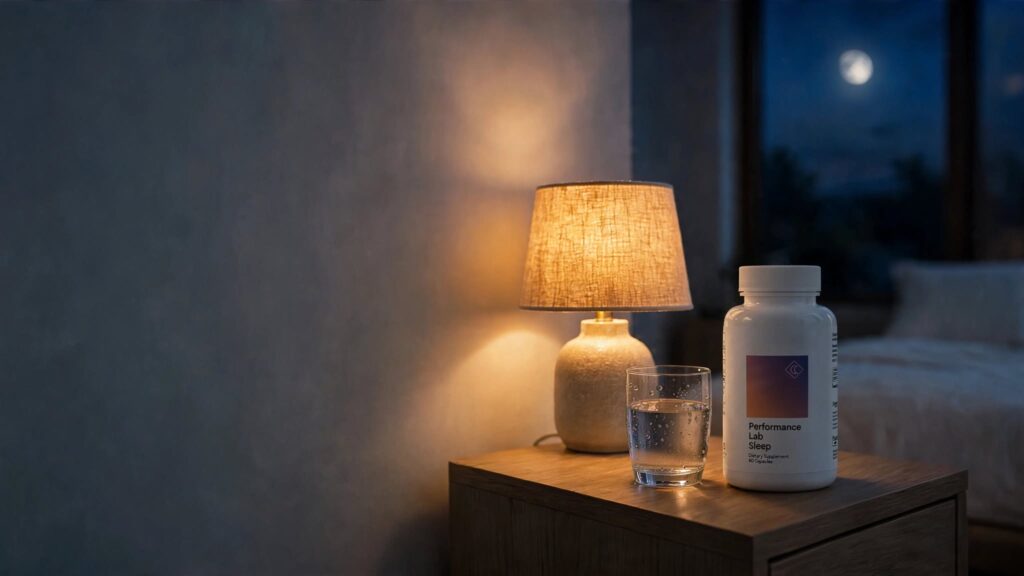
Our verdict: Performance Lab Sleep is a thoughtfully formulated sleep supplement, but it’s not a guaranteed solution for better sleep.
That’s not a dismissal of the product. The formula uses four ingredients—magnesium, Montmorency tart cherry, L-tryptophan, and lemon balm—with legitimate scientific research behind them. But the strength of that evidence varies, and research on individual ingredients doesn’t automatically prove that the finished Performance Lab Sleep formula will work for you.
So, is Performance Lab Sleep worth considering?
That’s what we’re going to find out.
In the sections below, we’ll look at exactly what’s in the formula, what the research actually tells us, whether those ingredients make sense for different sleep problems, how the product compares with melatonin, and what you should look for when choosing a sleep supplement.
By the end, you’ll have a much clearer answer to a more useful question than simply “Does it work?”
But before we get into that let’s see what is it and what’s inside Performance Lab Sleep.
What Is Performance Lab Sleep?
Performance Lab Sleep is a nighttime supplement made by Performance Lab. The current version is called Sleep v2.
The formula uses four main active ingredients:
- 100 mg magnesium
- 500 mg CherryPURE® whole Montmorency tart cherry
- 200 mg L-tryptophan
- 200 mg lemon balm extract
Those amounts are listed per serving of two capsules. The company recommends taking 2–4 capsules about 30 minutes before bedtime. The current product page lists a $44 one-time purchase price.
The product does not contain added melatonin. Instead, Performance Lab says the tart cherry provides naturally occurring melatonin and describes the formula as a way to support sleep without using a large dose of synthetic melatonin.
The capsules are made from pullulan rather than gelatin, making the product suitable for vegans. The manufacturer also states that the product is gluten-free, caffeine-free, free of artificial colors and preservatives, and third-party tested for purity and potency. Those are manufacturer-reported product characteristics, rather than independent conclusions about the product’s effectiveness.
Performance Lab Sleep at a glance
| Feature | Details |
|---|---|
| Product | Performance Lab Sleep v2 |
| Type | Nighttime sleep supplement |
| Serving size | 2 capsules |
| Main ingredients | Magnesium, tart cherry, L-tryptophan, lemon balm |
| Added melatonin | No |
| Suggested use | 2–4 capsules, 30 minutes before bed |
| One-time price checked | $44 |
| Vegan | Yes |
| Gluten-free | Yes |
| Caffeine-free | Yes |
| Proprietary blend | No |
Product details can change, so check the manufacturer’s page for the current formula and price before buying.
What’s Inside Performance Lab Sleep?
The ingredient list is where this product becomes more interesting.
Instead of relying on one active ingredient, Performance Lab combines a mineral, a fruit extract, an amino acid, and a botanical.
But does that combination actually make sense?
Let’s look at each ingredient.
Magnesium
Magnesium is an essential mineral involved in hundreds of processes in the body, including normal nerve and muscle function. Performance Lab uses 100 mg of magnesium per two-capsule serving, supplied as magnesium bisglycinate, taurate, and NutriGenesis®.
Magnesium is also one of the most common ingredients you’ll see in sleep supplements.
The reason is plausible: magnesium is involved in nervous-system function, and researchers have investigated whether supplementation can improve sleep.
A 2026 systematic review of randomized controlled trials found that results from magnesium studies were inconsistent and that the certainty of evidence was low to very low. The authors concluded that current evidence does not support oral magnesium as a routine treatment for insomnia, although some people may experience modest benefits.
An earlier review focused specifically on older adults with insomnia found that magnesium supplementation reduced sleep-onset latency by about 17 minutes compared with placebo.
So magnesium is a reasonable ingredient to investigate—but it’s not accurate to describe it as a proven sleep treatment.
Tart Cherry
The second major ingredient is CherryPURE® whole Montmorency tart cherry, concentrated at a 50:1 ratio. The product provides 500 mg per two-capsule serving.
Tart cherries are interesting because they contain melatonin as well as other compounds such as anthocyanins.
One small randomized, double-blind, placebo-controlled study found that tart cherry juice concentrate increased urinary melatonin levels and improved some measures of sleep in healthy adults.
A 2025 systematic review identified seven interventional studies. Three reported significant improvements in sleep-related measures and three reported increased melatonin levels, but the review also highlighted major differences in dose, duration, and participant characteristics and concluded that the evidence remains limited.
So tart cherry is promising, but it isn’t a guaranteed natural sleep solution.
L-Tryptophan
L-tryptophan is an amino acid involved in the body’s production of serotonin and melatonin.
That gives it an obvious connection to sleep biology.
Performance Lab Sleep provides 200 mg per two-capsule serving.
A systematic review and meta-analysis of tryptophan supplementation found that it could reduce wake time after sleep onset. Interestingly, the analysis found a stronger effect in studies using 1 gram or more of tryptophan compared with lower doses.
That’s an important detail when evaluating this product.
The fact that tryptophan has been studied for sleep doesn’t mean that 200 mg of tryptophan in Performance Lab Sleep will produce the same effect seen in higher-dose studies.
That’s one reason I wouldn’t describe the product simply as “clinically proven.”
The evidence is more nuanced than that.
Lemon Balm
The fourth ingredient is lemon balm extract, supplied at 200 mg per two-capsule serving.
Lemon balm has traditionally been used for relaxation, and researchers have investigated its potential effects on anxiety and sleep.
There is some encouraging clinical research. For example, a recent double-blind, placebo-controlled crossover study found that a particular standardized Melissa officinalis extract formulated as a phytosome reduced insomnia severity compared with placebo.
But there’s another important limitation: that study used a specific standardized extract and formulation.
You can’t automatically assume that 200 mg of any lemon balm extract will produce the same result.
That’s a common problem with supplement research. The ingredient name may be the same while the extract, concentration, dose, and delivery system are different.
What Does the Research Actually Say?
This is where the Performance Lab Sleep review gets more interesting.
It’s easy to look at the four ingredients and say:
“They’re all research-backed, so the product must work.”
That’s not how the evidence works.
What looks promising?
There is legitimate research behind all four ingredients.
Magnesium has been studied in adults with poor sleep and insomnia, although recent reviews describe the evidence as inconsistent.
Tart cherry has shown potential effects on sleep and melatonin in some studies, but other controlled trials have found no meaningful sleep benefit.
Tryptophan has shown some potential for reducing wakefulness after sleep onset, particularly at higher doses than the 200 mg supplied by a two-capsule serving of Performance Lab Sleep.
Lemon balm also has encouraging findings, but the research varies by extract and formulation.
So the ingredients are plausible and have some supporting research.
Want to take a closer look? Explore Performance Lab Sleep & check the current formula and price →
Affiliate Disclosure: This article contains affiliate links. If you purchase Performance Lab Sleep through one of our links, we may earn a commission at no extra cost to you. Our review is based on the product’s formula, available research, and our assessment of what it offers.
Could Performance Lab Sleep Help With Your Sleep Problem?
This depends partly on what your actual problem is.
“Poor sleep” is a broad description.
Someone who takes an hour to fall asleep isn’t necessarily dealing with the same issue as someone who wakes repeatedly during the night.
If you have trouble falling asleep
Performance Lab Sleep is designed with this problem in mind.
The manufacturer specifically says the formula is intended to support falling asleep, and its ingredients include magnesium, L-tryptophan and lemon balm.
There is some scientific basis for investigating these ingredients, particularly around relaxation and sleep-related outcomes.
In other words:
There is a plausible reason to try it. There isn’t a guarantee that it will work.
If you have trouble staying asleep
This is a different question.
If you routinely wake during the night, don’t assume that any sleep supplement will solve the problem.
Your nighttime awakenings could be influenced by your sleep schedule, alcohol, caffeine, stress, medications, pain, bathroom trips, your sleep environment, or an underlying sleep disorder.
Performance Lab Sleep may help here but it doesn’t establish that this particular formula will prevent nighttime awakenings.
If staying asleep is your main problem, our guide to trouble staying asleep goes into the issue in more detail.
If you wake up tired
There’s another possibility worth considering.
You may be sleeping for what looks like enough hours but still not getting good-quality, consolidated sleep.
A supplement isn’t necessarily the answer if the underlying issue is something else.
For example, persistent insomnia is a condition that deserves more than a supplement-first approach. The American Academy of Sleep Medicine recommends cognitive behavioral therapy for insomnia (CBT-I) as a first-line treatment for chronic insomnia in adults.
And if you’re regularly waking exhausted despite allowing enough time for sleep, it’s worth discussing the problem with a healthcare professional rather than continually adding supplements.
When a sleep supplement may not be enough
This is perhaps the most important limitation to understand.
A sleep supplement can’t compensate for every cause of poor sleep.
If your sleep problem is persistent, severe, getting worse, or accompanied by other concerning symptoms, the goal should be to identify what’s driving it—not simply find a stronger supplement.
Performance Lab Sleep can be viewed as a supplement to a broader sleep strategy, not a replacement for investigating persistent sleep problems.
Performance Lab Sleep vs. Melatonin: Is It a Good Alternative?
This is one of the more interesting questions about the product.
Performance Lab Sleep does not add synthetic melatonin. Instead, it combines tart cherry with L-tryptophan, magnesium and lemon balm.
That makes it fundamentally different from a simple melatonin supplement.
| Performance Lab Sleep | Melatonin supplement | |
|---|---|---|
| Main approach | Multi-ingredient formula | Single active ingredient |
| Added melatonin | No | Usually yes |
| Main ingredients | Magnesium, tart cherry, L-tryptophan, lemon balm | Melatonin |
| Formula complexity | Higher | Lower |
| Approach | Several ingredients with different roles | Direct melatonin supplementation |
So is Performance Lab Sleep a good alternative to melatonin?
It can be, depending on what you’re looking for.
If you specifically want melatonin itself, a melatonin supplement is obviously the more direct approach.
If you’d rather try a multi-ingredient formula without adding a standalone melatonin dose, Performance Lab Sleep takes a different approach.
Neither approach is automatically right for everyone.
And there’s another point worth remembering: the Performance Lab formula’s tart cherry provides naturally occurring melatonin, according to the manufacturer, but the product page doesn’t give a specific amount of melatonin per serving.
So I wouldn’t compare the product to a melatonin supplement based on “equivalent melatonin dose.” We don’t have enough product-specific information to make that comparison.
What Should You Look for in the Best Sleep Supplement?
If you’re shopping for the best sleep supplement for your situation, don’t start with the marketing headline.
Start with the label.
1. Are the doses clearly listed?
A transparent supplement should tell you how much of each active ingredient you’re getting.
Performance Lab does this. There is no proprietary blend hiding the individual amounts.
That’s useful because you can compare the actual formula rather than just comparing ingredient names.
2. Is there research behind the ingredients?
This is important—but don’t stop there.
Look at:
- the dose used in studies
- the form of the ingredient
- the population studied
- how long the study lasted
- what outcome actually improved
“Studied in humans” is not the same as “proven to work.”
3. Does the formula match your goal?
Think about your actual sleep problem.
Do you have trouble falling asleep?
Do you wake during the night?
Do you wake too early?
Or are you sleeping enough but still feeling unrefreshed?
A supplement designed around sleep shouldn’t be judged separately from the problem you’re trying to solve.
4. Are you paying for ingredients you actually want?
More ingredients don’t automatically make a supplement better.
A four-ingredient formula may be useful if you like a multi-ingredient approach.
But if you want one specific ingredient, a simpler product may make more sense—and could cost less.
5. Does the company provide enough information to evaluate the product?
Performance Lab publishes the individual ingredient amounts, the capsule ingredients and its manufacturing/testing claims on the product page.
That’s helpful from a buyer’s perspective.
It still doesn’t replace independent clinical evidence on the finished product.
Performance Lab Sleep Pros and Cons
Potential advantages
- Transparent formula: The amounts of the four main active ingredients are listed.
- No proprietary blend: You can see how much of each ingredient you’re getting.
- No added melatonin: The formula takes a different approach from a conventional standalone melatonin supplement.
- Four different ingredients: The formula combines magnesium, tart cherry, L-tryptophan and lemon balm.
- Vegan capsules: The manufacturer uses pullulan capsules rather than gelatin.
- Caffeine-free: The product is designed specifically as a nighttime formula.
- Simple routine: The recommended use is two to four capsules before bed.
Potential drawbacks
- The evidence isn’t equally strong for every ingredient.
- The tryptophan dose is lower than the ≥1 g dose associated with stronger effects in one meta-analysis.
- Tart cherry research is mixed. Some studies are encouraging, while others found no significant sleep improvement.
- A multi-ingredient formula isn’t necessarily better than a simpler option.
Is Performance Lab Sleep Worth It?
After looking at the formula and the evidence, I wouldn’t describe Performance Lab Sleep as a miracle sleep solution.
But I also wouldn’t dismiss it.
The formulation is reasonable. The ingredients aren’t random, the amounts are disclosed, and there is legitimate research investigating each of them.
The bigger question is how much confidence you should place in the finished product.
At the moment, I’d put it this way:
It may be worth considering if:
- You want a melatonin-free, multi-ingredient sleep formula.
- You prefer taking one product rather than buying several individual ingredients.
- You value transparent ingredient amounts.
- You’re looking for something to complement good sleep habits rather than replace them.
- You understand that the evidence is promising in places but not conclusive.
There’s also a practical consideration: the current two-capsule serving provides 200 mg of L-tryptophan, while the tryptophan meta-analysis found stronger effects at doses of 1 gram or more. That doesn’t mean the Performance Lab formula won’t work; it means we shouldn’t assume that evidence from higher-dose studies directly predicts the result you’ll get from this product.
Performance Lab Sleep Review: Final Thoughts
Performance Lab Sleep is more interesting than a generic “natural sleep aid,” mainly because the formula is transparent and combines four ingredients that have at least some scientific rationale behind them.
But the honest review is more nuanced than saying it’s one of the best sleep supplements available.
Magnesium has mixed evidence. Tart cherry is promising but inconsistent. L-tryptophan has some supportive evidence, particularly at higher doses than this product provides. Lemon balm is also promising, but research findings depend on the specific extract and formulation.
So, does Performance Lab Sleep really help you sleep better?
It may help some people, but the current evidence doesn’t allow us to promise that it will work for everyone.
If you’re specifically looking for a transparent, multi-ingredient, melatonin-free sleep supplement, Performance Lab Sleep is a product worth examining.
If you’d rather keep things simple, want a single ingredient, or have persistent sleep problems, another approach may make more sense.
The important thing is to match the product to the problem—not the other way around.
Want to see the current formula and price?
Disclosure: This article is for educational purposes and isn’t medical advice. If you take medications, have a medical condition, are pregnant or breastfeeding, or have persistent sleep problems, discuss supplement use with a qualified healthcare professional. Magnesium supplements can interact with some medicines, and excessive supplemental magnesium can cause gastrointestinal side effects. This article contains affiliate links. If you purchase a product through one of our links, Brain Habit may earn a commission at no additional cost to you.
Sources
- Performance Lab — current Sleep v2 product information and Supplement Facts.
- Lopresti A.L., Smith S.J., Drummond P.D. — Magnesium Supplementation for Sleep in Adults: A Systematic Review of Randomized Controlled Trials (2026).
- Barforoush F. et al. — The Effect of Tart Cherry on Sleep Quality and Sleep Disorders: A Systematic Review (2025).
- Sutanto C.N. et al. — The impact of tryptophan supplementation on sleep quality: a systematic review, meta-analysis, and meta-regression (2022).
- Effects of Melissa officinalis Phytosome on Sleep Quality — randomized, placebo-controlled crossover study.
- NIH Office of Dietary Supplements — Magnesium fact sheet.
- American Academy of Sleep Medicine — behavioral and psychological treatment guidance for chronic insomnia.